Table of Contents
Overview of SAMF: The Subcritical Aerosol-Moisture Feedback
The Subcritical Aerosol-Moisture Feedback (SAMF) is a 📖 newly proposed framework that explains how aerosols and moisture interact when the planetary boundary layer (the lowest ~1 km of the atmosphere affected by Earth’s surface) exists in a subcritical state, before deep convection (intense, sustained vertical motion) begins. In the SAMF regime, subtle differences in aerosol composition (particularly in their interactions with water) govern how energy is vertically redistributed through the boundary layer. Compositional differences across the boundary layer determine whether energy remains confined near the surface or is released aloft through condensation, thereby shaping local temperature, humidity, and stability patterns over time.

SAMF challenges the traditional view that most aerosols primarily absorb infrared radiation. Instead, it proposes that many subcritical aerosols, especially those of mixed or weakly absorbing composition, scatter infrared radiation, altering the direction and coherence of radiative flux within the boundary layer. This scattering reorients the paths of both upward and downward infrared energy, creating subtle spatial inhomogeneities in heating rates. Over time, these variations produce localized pockets of slightly warmer or cooler air, modulating lapse rates (the rate at which temperature decreases with height) and gradually building or releasing convective inhibition (CIN): the energetic barrier that determines whether parcels can rise freely into deep convection. How does aerosol composition affect these processes? Read on to find out.
Download an AI-generated Infographic summarizing this post:
Hydrophilic Particle Regime and Storm Initiation
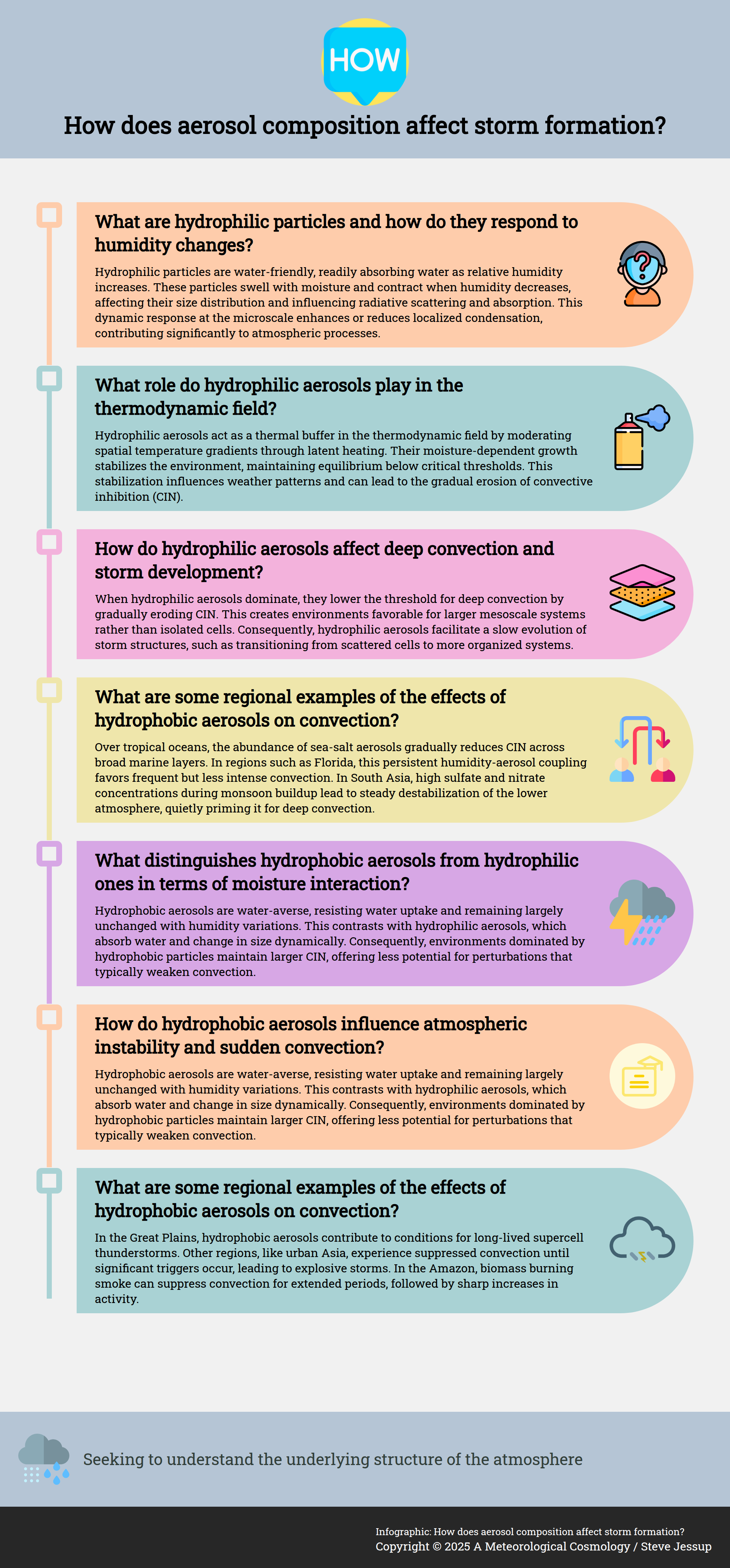
When the particle population is mostly hydrophilic (“water-friendly”), particles readily absorb water, swelling as relative humidity (RH) increases or shrinking as RH decreases. Thus, changes in RH alter the particles’ size distribution in pockets of locally more or less humid air, which feeds back to enhance or reduce condensation in these microscale pockets of activity. In a hydrophilic regime, SAMF is greatest at the microscale.
Hydrophilic aerosols respond dynamically to humidity, swelling and contracting on micron scales as relative humidity fluctuates, making SAMF’s feedback most pronounced at the microscale.
Across the macroscale thermodynamic field, latent heating associated with humidity-dependent aerosol growth acts as a thermal buffer, moderating spatial temperature gradients and stabilizing the environment. When hydrophilic particles dominate, transient hydration and deliquescence (abrupt transition to a desiccated state) continually inject small perturbations into the vapor field. These micro-events locally release latent heat, drive humidity fluctuations, and generate microscale convective perturbations that propagate upward. Through sub-scale heterogeneity, the macroscale field is held in an equilibrated state that is subtly maintained below a critical threshold.

In marginal environments where either supercells or larger mesoscale systems could be produced, the predominant aerosol type may be able to tip the balance. When hydrophilic aerosols dominate, the buffered aerosol-moisture-radiation interactions of SAMF smooth its effects across space and time, gradually altering lapse rates and slowly eroding CIN. The gradual erosion of CIN lowers the threshold required for deep convection.
At regional scales, these cumulative changes favor the development of larger mesoscale systems rather than cellular convection. In this regime, convection arises from the upscaled effects of field adjustments, setting the stage for convergence along weak gradients, cloud-layer moistening, and widespread release of latent heat in stratiform or anvil regions. The more likely outcome is a slow evolution of storm morphology from scattered cells to structured systems.
🌊 Examples of hydrophilic particles:
- Sea salt is strongly hygroscopic and rapidly swells with humidity, especially in maritime environments.
- Ammonium sulfate and ammonium nitrate from industrial or agricultural sources absorb water readily, especially under polluted continental conditions.
- Secondary organic aerosols that have undergone oxidation become more water-friendly and participate in continuous size changes as humidity changes.
🌍 Regional expressions:
- Over tropical oceans, the abundance of sea-salt aerosols gradually reduces CIN across broad marine layers. In regions such as Florida, this persistent humidity-aerosol coupling favors frequent convection but rarely the explosive updrafts seen in the drier, more strongly capped environments of the Great Plains.
- In South Asia, high sulfate and nitrate concentrations during monsoon buildup lead to steady destabilization of the lower atmosphere, quietly priming it for deep convection.
Hydrophobic Particle Regime and Storm Initiation
When the aerosol population is hydrophobic (“water-averse”), particles resist water uptake, remaining largely unchanged across humidity variations.
Although radiation encountering hydrophobic aerosols is mainly scattered, structural heterogeneity within the particles’ composition causes localized confinement of the radiation that effectively mimics weak absorption via scattering effects on nanometer scales. Hydrophilic aerosols, by contrast, absorb energy through real thermodynamic processes within water films at the microscale, converting radiation to latent and sensible heat. Thus, both types influence radiative balance through energy retention: hydrophobic aerosols via nanoscale electromagnetic confinement, and hydrophilic aerosols via microscale phase-mediated absorption.
Hydrophobic aerosols retain energy through nanoscale electromagnetic confinement, while hydrophilic aerosols do so through microscale phase-mediated absorption.
Where hydrophilic aerosols lower the threshold for deep convection, hydrophobic aerosols maintain it, making the failure more catastrophic if and when it occurs. While most of the field maintains its temperature and moisture state, localized regions can cool or warm much more unevenly, producing sharp but isolated gradients of instability. Compared to an environment dominated by hydrophilic particles, environmental conditions at the microscale in a hydrophobic regime persist in a steady state, and CIN remains larger, with fewer small perturbations to weaken it.

Macroscale and microscale homogeneity makes the atmosphere appear stable until enough forcing accumulates to trigger a sudden, catastrophic failure of the subcritical state. This results in an episodic burst of instability and the onset of deep convection. Instead of continuous background influence, SAMF in this regime behaves like a switch: mostly off, then suddenly on. Marginal environments dominated by hydrophobic particles therefore have a greater probability of sudden threshold shifts, where cellular storms erupt suddenly once the barrier is overcome.
🏙 Examples of hydrophobic particles:
- Black carbon, or soot, from fossil fuel combustion resists water uptake and remains highly absorbing.
- Mineral dust contains fractions that are poorly hygroscopic, depending on source region and composition.
🌍 Regional expressions:
- In the Great Plains of the U.S., the combination of large CIN and hydrophobic aerosols creates the conditions for large, long-lived supercell thunderstorms.
- In urban and industrial Asia, soot-dominated air often suppresses convection until strong triggers arrive, at which point explosive outbreaks occur.
- In Saharan outflow across the Atlantic, dust layers maintain strong stability and suppress convection until large-scale forcing is sufficient to break through. These dust layers can significantly hold back hurricane development.
- In the Amazon during the dry season, smoke from biomass burning creates sharp episodic bursts of deep convection after long periods of suppression.
Shifting Proportions and Transitional Dynamics
Aerosol hydration can change over time, produced by a sequence of chemical reactions that chemically weather hydrophobic aerosols.
- An increase in hydrophilicity, producing efflorescence (aerosol wetting), shifts the SAMF response toward gradual integration. Instead of sudden events, the feedback works more continuously in the background, smoothing gradients and reshaping the thermodynamic field in quieter but more sustained ways.
- An increase in hydrophobicity, producing deliquescence (aerosol desiccation) shifts the SAMF response toward punctuated release. Stability holds, until just enough forcing accumulates to flip the system, initiating deep convection.
Surface oxidation and aging
Primary organic or soot particles are often initially hydrophobic. Gas-phase oxidants (especially •OH, O₃, and NO₃ radicals) react with exposed carbonaceous and organic components, forming functional groups such as hydroxyl, carbonyl, or carboxyl chemical groups. These reactions are chemically analogous to low-temperature weathering: the addition of oxygen and hydrogen increases polarity and allows water molecules to hydrogen-bond to the particle surface. As a result, hygroscopicity increases with time.
Oxidation weathers hydrophobic particles, adding polar chemical groups that increase hygroscopicity and allow water to bind.
Condensational growth and secondary coatings
Simultaneously, oxidation in the gas phase produces more water-soluble vapors (e.g., sulfuric acid, nitric acid, low-volatility organics) that condense onto existing particles. Each thin coating layer further enhances hygroscopic behavior, similar to a mineral surface acquiring secondary clays or oxides. This chemical weathering response proceeds most efficiently in moist, irradiated boundary layers, precisely the conditions relevant to SAMF.
In moist, sunlit boundary layers, gas-phase oxidation coats particles with soluble compounds, steadily increasing their hygroscopicity.
Microphysical and radiative consequences
As hygroscopicity increases, aged aerosols act as more efficient CCN and grow at lower supersaturations, modifying cloud droplet number, size distribution, and optical depth. In the context of SAMF, this increase in hydroscopicity with time amplifies the feedback loop: particles that initially suppressed condensation later become condensation catalysts, shifting the local aerosol-moisture equilibrium and potentially triggering delayed convection once sufficient hydration and coalescence occur.
Aging turns scattering aerosols into condensation catalysts, shifting SAMF from suppression to activation.
🌍 Examples of shifting regimes:
- In West Africa during seasonal transition, dust dominance in spring gradually gives way to sulfate and sea salt during monsoon onset, shifting SAMF behavior from episodic to gradual.
- In the Amazon basin, the wet season is dominated by oxidized secondary organics (more hydrophilic), while the dry season is dominated by hydrophobic smoke, flipping SAMF’s character with the calendar.
- Aerosols lifted over the Rockies and advected eastward frequently arrive in the Northeast U.S. as discrete elevated layers. When these layers are re-moistened in pre-storm environments, chemically aged particles can activate as cloud condensation and ice-nucleating nuclei, subtly enhancing mixed-phase processes. Under favorable dynamical conditions, this can contribute to enhanced supercooled water and increase the probability of large hail.
Mixed Particle Populations and Storm Formation
Most real-world cases involve mixed populations of hydrophilic and hydrophobic particles, or particles of mixed compositions, producing hybrid behaviors.
As we’ve seen, hydrophilic particles act as a steady, subtle background force, constantly redistributing energy at the microscale and gradually weakening CIN. Hydrophobic particles overlay this with punctuated bursts of microscale variability. In combination, they create a two-step destabilization: gradual erosion followed by sudden failure and potential storm initiation.

Some aerosols are not purely one type or the other but conglomerates composed of both organic material and inorganic salts. These internally mixed particles can take up water unevenly across their surfaces, scatter light differently depending on the balance of their components, and, as in the last section, they can even generate an evolving response over time as relative humidity changes. Their complex nature makes the SAMF response more difficult to predict, blending elements of both smoothing and persistence in ways that vary with particle history and composition.
Hybrid aerosols blur the line between radiative and microphysical behavior, making SAMF’s response a moving balance of smoothing and persistence.
🌪 Examples of particles with dual properties:
- Aged dust often transitions from largely hydrophobic to more hydrophilic as it acquires sulfate, nitrate, or organic coatings during transport.
- Fresh organic aerosols from biomass burning are typically a mixture of hydrophilic and hydrophobic particles, with the hydrophilic fraction increasing as the particles undergo chemical aging in the atmosphere.
- Volcanic ash is weakly hygroscopic in its fresh form but can exhibit more hydrophilic behavior when coated with soluble salts from volcanic gases.
- Soot is strongly hydrophobic when freshly emitted but can become partially hydrophilic as it mixes with or is coated by sulfates and nitrates.
🌾 Examples of mixed environments:
- In the eastern United States during summer, sulfates (hydrophilic) mix with soot and organics (hydrophobic), producing a chemical mix in a humid atmosphere where stability erodes steadily but still supports sharp storm outbreaks.
- In the Mediterranean region, sea salt mixes with dust and smoke from the surrounding land, creating alternating periods of smooth buildup and sudden convective release.
- In East Asia, nitrate– and sulfate-rich particles can combine with soot, resulting in aerosols whose scattering and hygroscopic properties change rapidly with atmospheric processing.
Aerosol Particle Influence on SAMF During the April 8, 2024 Solar Eclipse in Columbus, GA
In the context of my own work, the prescribed burn in west-central Georgia during my 📖 eclipse case study offers a useful illustration. Fires in pine-dominated forests and their undergrowth release large amounts of organic smoke particles. At emission, these aerosols contain a mixture of hydrophilic and hydrophobic components, with a tendency to begin hydrophobic, and becoming more hydrophilic as they age and undergo chemical transformation in the atmosphere. While this chemical transition typically unfolds over long time periods of days to weeks, the mix of hydrophobic aerosols from the burn, hydrophilic aerosols from anthropogenic combustion over Columbus, and deep, blue sky above the boundary layer may have produced just the right recipe for an amplified SAMF response.
Decreasing solar radiation from the eclipse set the SAMF regime in motion. The immediate effect on the boundary layer as the smoke layer passed over Columbus was shaped by the predominance of freshly emitted, largely hydrophobic aerosols. These particles suppressed the microscale, cumulative adjustments that would normally erode CIN, keeping the boundary layer locked in a stable state. At the same time, a smaller fraction of hydrophilic particles likely condensed and evaporated thin films of liquid water as RH fluctuated near the deliquescence (drying) threshold. Even a 1–2% change in RH can alter visibility under such conditions, a sign that aerosol water content was shifting in ways that, paradoxically, reinforced the persistence of the background state.

The reversible uptake and release of water from hygroscopic surfaces dampens variations in both temperature and dewpoint, while brief changes in visibility suggest punctuated exchanges of aerosol water and water vapor across particle sizes. These sudden shifts in the field likely enabled both temperature and moisture to be maintained at steady state for more than half an hour. Meanwhile, the likelihood of deep convection remained extremely low during this time period due to the persistence of CIN and the declining radiative forcing produced during the eclipse.
During the eclipse, hydrophobic smoke maintained the stability of the boundary layer while a smaller hygroscopic fraction buffered temperature and moisture, producing an unusually long steady state.
This case shows that hydrophobic-dominated environments can stabilize thermodynamic conditions even as a portion of the aerosol population undergoes rapid changes in wetting. The dynamics observed in west-central Georgia during the eclipse represent just one of the many broader patterns seen globally: from the suppressed-but-explosive convection of Amazon dry-season smoke to the stabilizing influence of Saharan dust outflow. In each case, the relative balance of hydrophilic and hydrophobic particles in conjunction with environmental conditions governs the nature of the SAMF response.
A Hypothetical Eclipse-Deep Convection Scenario
In Columbus, the peak of the smoke plume occurred before the peak of the eclipse. While the system remained well below the threshold of deep convection, a large stratocumulus cloud formed downwind as the radiative forcing increased after peak eclipse. If a smoke plume were instead to advect over an urban area AFTER the peak of the eclipse, could there be a scenario where deep convection could initiate?
If a smoke plume were to pass over an urban area after the eclipse peak, solar radiation rebounds quickly, restoring surface heating and deepening the boundary layer. The renewed mixing reduces CIN and revives buoyant potential that had been muted during the period of diminished shortwave flux. Into this recovering, enhanced environment, the densest portion of the smoke plume arrives, advecting elevated aerosol optical depth (AOD) across part of the domain. Beneath the plume, the surface remains shaded and cooler, while nearby clear areas warm rapidly. This horizontal thermal contrast produces low-level pressure differences that organize shallow convergence and initiate rising motion near the plume edge.
When a post-eclipse smoke plume drifts over an urban landscape, the rapid rebound of solar heating and sharp plume-edge gradients can turn quiet air into zones of organized lift.
Along this boundary, the focused lift encounters moist, slightly destabilized air. Small cumuli tend to form first in these zones of contrast, tracing the sharp transition between irradiated and shaded sectors. Because the smoke has aged chemically during transport, its particles are more hygroscopic and activate efficiently as cloud condensation nuclei (CCN). The resulting clouds contain many small droplets, which enhances cloud-top radiative cooling and stabilizes their updrafts against entrainment. Together, the microphysical and thermodynamic effects amplify local ascent.
If CIN has already weakened sufficiently, this mesoscale lift, combined with slight cooling aloft from the radiative losses of the nascent cloud field, can tip surface parcels to their level of free convection (LFC). Once this threshold is crossed, towers can rise through the inversion and transition to deep convection. Thus, a post-eclipse, peak-plume sequence provides both the dynamic and microphysical ingredients needed for convective initiation within an otherwise marginally capped environment.
Conclusion: SAMF and Storm Formation
SAMF isn’t a single process with a single signature. It takes on different characteristics depending on the chemistry of the particles it interacts with.
- Hydrophilic particles (sea salt, sulfates) make SAMF stronger, steadier, and more subtle, embedding it into the background state of the atmosphere.
- Hydrophobic particles (soot, fresh organics, dust) make SAMF sharper, rarer, and more punctuated, potentially creating a sudden release of instability.
- Mixed populations combine both, combining gradual erosion with an increased potential for explosivity.
- Shifting balances generate transitional behaviors and thresholds that change storm timing and structure in complex ways.
- Local cases reveal how particle composition can hold the boundary layer in a suspended state, delaying instability even under unusual conditions like a solar eclipse.
To truly understand SAMF, we need to think not just about how many particles are in the air, but about what kind of particles they are, and where and when they dominate. SAMF gives us a new lens that explains boundary layer responses across settings (e.g., wildfire, urban) and how this activity can enhance or suppress the potential for deep convection.
Want to receive future posts related to this study in your inbox? Be sure to subscribe to this blog using the “Newsletter” link at upper right. This work is made possible by those who believe in it. Thank you for considering a gift to help ensure its continued momentum.
Author’s Note: This summary is freely available for educational use. Please cite “Jessup, S. (2025). When Aerosol Particles Tip the Balance: The Atmosphere’s New Feedback and Storm Formation” in scholarly work.