Table of Contents
Introduction
Airports, even small ones, act as localized sources of heat and disrupt the moisture balance near the surface. But how can something so limited in scale produce visible, immediate effects on clouds overhead?
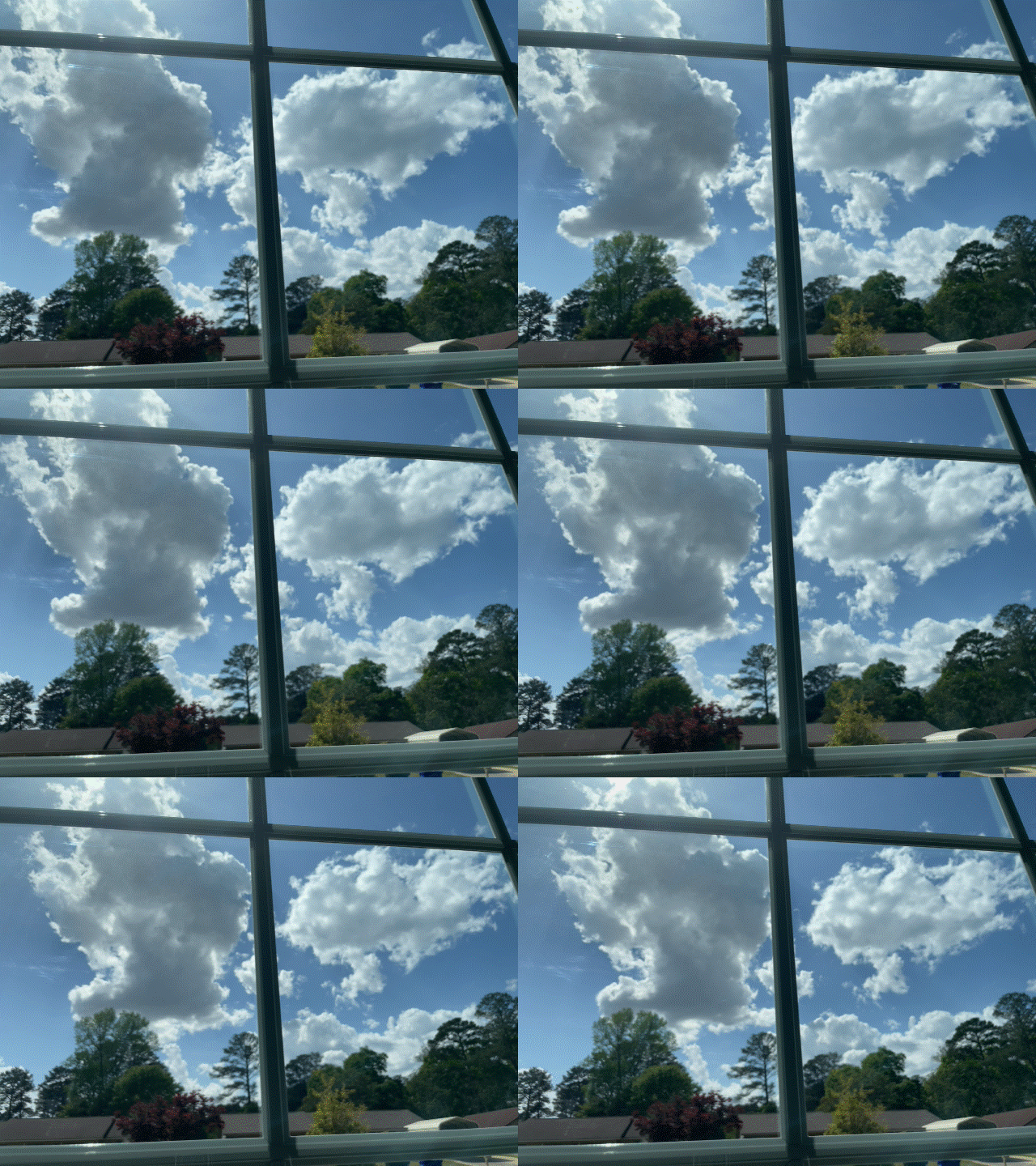
I found out on April 2, 2026. I set up my phone for a timelapse video (I had to do so from indoors, as it was too warm outside, and my phone would shut down). A cumulus cloud passing over the airport rapidly dissipated, captured at 3-second intervals. A second cloud followed just behind it. It didn’t collapse entirely, but it was massively diminished, with only the lower portion holding together. A series of smaller clouds then met a similar fate as they passed the same area. Watch the video below, then continue reading to discover what’s going on.
The Setting
Columbus (Georgia) Airport sits on the north side of town, just north of Peachtree Mall and not far from Columbus State University. The runway is surrounded by a broad area of tarmac: a wide, paved area that will heat up when baked by the sun. My house sits due east of the airport, two to three miles away.

The afternoon of the video was breezy, with a patchwork of cumulus clouds across western Georgia moving roughly from southeast to northwest. The rows of clouds are indicative of horizontal convective rolls: counter-rotating tubes of low-level air that parallel the wind direction. Bands of higher, cirriform clouds were approaching from the west. As afternoon heating continued and progressed toward evening, the cumulus coverage thinned, while some clouds grew larger, especially across northwest Georgia.
The morning weather balloon soundings from Birmingham, AL and Peachtree City, GA showed a reasonably steep low-level lapse rate, indicating enough instability to form broad cloud coverage, but not enough for these clouds to grow into storms, and a moderately humid environment. Winds were lighter at Peachtree City, especially at low levels, compared to Birmingham. Columbus was situated in the gradient between these light to moderately strong winds.

The wind speed approached 30 knots at about 1.2 km in Birmingham. Here in Columbus, it’s reasonable to assume that the winds at cloud level were around 15-20 knots, somewhat stronger than at Peachtree City. Wind speed profiles for Peachtree City and Birmingham are shown below.

and Birmingham, AL on April 2, 2026 at 12 UTC.
The environment was slightly more humid in Peachtree City than in Birmingham, with cloud-level relative humidity likely around 70% in Columbus. There was quite a bit of vertical variability throughout the humidity profile, which, along with the brisk winds, suggests conditions favorable for enhanced entrainment of dry air into the clouds, making them more susceptible to dissipation. This is important to keep in mind as we dissect the reasons for cloud break-up over the airport.

Now that we have a sense of the general conditions on this day, let’s dig into why the clouds were dissipating over the airport.
Dissecting the cloud dissipation
Let’s begin by looking at the dissipation of the first cloud in slow motion (0.25x speed). From the beginning of the video, you can see a rising shadow associated with a buoyant plume that juts up over the cloud top, indicating a strong thermal that had formed over the airport.

The early stages of the cloud’s dissipation proceed from bottom to top and rear to front, suggesting that the cloud’s environment is more resistant at first but less adaptable over time. A second cloud approaches from behind.

Eventually, only an elevated core of the cloud remains; once its break-up begins, the forward portion of this core pushes ahead faster than the bulk of the cloud.

As the cloud stretches out, the pace of its dissolution accelerates. Within minutes, the cloud is gone. The second cloud will soon experience a similar fate.

You can watch a slow-motion time lapse of this entire sequence:
Thermodynamic contrasts
I usually employ a process-based approach in interpreting the atmosphere. The primary influence of the airport on the cloud’s dissipation is through thermodynamic processes. The wide, paved area of runway and tarmac heats the surface, producing a locally enhanced flux of sensible heat into the boundary layer (the layer near the surface that is affected by surface processes). Lacking vegetation, the airport experiences reduced evapotranspiration and moisture flux. With enhanced sensible heating and reduced latent heating, the Bowen ratio is elevated. Not only are the rising plumes of air warmer, they are also drier than the surrounding air. When ingested into the cloud environment, they can accelerate evaporation.
Maintenance of cumulus often depends on a delicate feedback between intermittent shading, localized cooling, moisture retention beneath cloud streets or patches, and renewed thermal generation at cloud edges and sunlit gaps. Over a large paved surface, the thermal inertia and optical properties of the surface can distort that feedback. Even when a cloud temporarily shades the pavement, the surface will remain comparatively warm because of stored heat, while nearby vegetated zones cool more quickly in response to shading.
In typical environments ,surface heterogeneity reduces the local thermal contrast that sometimes helps organize cloud-sustaining circulations. Over the airport, the paved complex can weaken the fine-scale surface response to cloud forcing, which in turn weakens the mutual adjustment between cloud and surface that helps maintain shallow convective fields.
Kinematic disruption
In addition to the thermal contrast between the airport and surrounding neighborhoods, the reduced surface roughness of the airport adds an additional discontinuity to the generally more heterogeneous patchwork of trees, homes, roads, and buildings. Fueled by the roughness and thermal differences, the airport can introduce localized perturbations in the barometric pressure field that can generate small-scale patterns of convergence and divergence, which can, in turn, set up local circulations. In this way, even a small airport can help to reorganize the boundary-layer circulation.
The strong thermal contrasts and decreased surface roughness can also enhance low-level winds over the airport, increasing both wind shear (difference in wind with height) and turbulence (localized pockets of rough air) that can disrupt the updraft core of a cloud. The thermals produced over an airport may be more robust, but also more fragmented and more rapidly mixed with environmental air than those generated over more heterogeneous terrain. This kinematic response can produce broken, sheared filaments that may produce bursts of rising motion, but can also reduce the overall buoyant support for the cloud.
Microphysical and mixing effects
A “healthy” cumulus cloud requires continuous moisture supply from below, which helps condensation to continually outpace evaporation. Over the impervious surface of an airport, though, moisture supply is reduced, rising air parcels are warmer but drier, and increased entrainment from the surroundings introduces unsaturated air. Lacking reinforcing moisture, the support from below may no longer sustain the cloud, and evaporation may begin to take over.
When cloud edges entrain dry air, droplets evaporate, producing latent cooling. This generates parcels of negatively buoyant air that sink and pull cloud fragments downward. This enhances mixing even further. However, this activity occurs in patches, such that some parts of the cloud rise, while others sag or collapse. At the edges of the cloud, ventilation increases, enhancing the penetration of dry air. All of this implies that as a cloud passes over the airport, it moves from a buoyancy-driven to a mixing-driven regime. The additional mixing helps to dissipate the cloud.
The Second Cloud
Environmental Preconditioning by the First Cloud
How did the first cloud alter the environment for the second cloud? To begin with, the rapid dissipation of the first cloud produced widespread evaporative cooling aloft. This cooling can produce opposite effects: on the one hand, elevated cooling can increase the vertical temperature gradient (the “lapse rate”), which acts to destabilize the air and promote rising motion.
However, the increased instability only benefits the second cloud if it can access that instability, if the air remains moist during ascent, and if excessive entrainment can be avoided. The increased mixing and potentially reduced coherence of updrafts after the first cloud dissipated, along with the potential intensification of turbulence, oppose the lapse rate influence and may prevent the second cloud from utilizing this instability.
The cooling also generates negative buoyancy, making the air denser than its surroundings and encouraging sinking motion. The cooling can also produce descending filaments, turbulent mixing, and enhanced entrainment. The end result is that even though the environment might be thermodynamically more favorable, the kinematic result is a mechanically mixed, disordered layer – which would help to promote the dissolution of the second cloud.
Even if parcels might rise more rapidly as the lapse rate steepens, these parcels rising from below will encounter stronger shear, increased density gradients, and turbulent mixing zones, which can disrupt ascent, dilute moisture, and increase entrainment before the parcels can capitalize on the steeper lapse rate. Practically, the cooling produced by the dissipation of the first cloud reduces the “survivability” of subsequent parcels: their energy goes into dissipative processes, such as mixing, filamentation, evaporation, and disrupted overturning, rather than building or reinforcing clouds.
Take a minute to review the dissipation of the second cloud below. What differences do you see in this cloud as compared to the first?
Dissipation of the Second Cloud
The second cloud is beginning to split apart even as it enters the frame. As it passes over the airport, vigorous updrafts penetrate the forward flank and center of the cloud. Rather than reinforcing it, they accelerate its dissolution. The top of the cloud rapidly collapses and evaporates, even as a thermal pushes upward from below. The updraft is temporarily maintained, but it eventually weakens, too, and only the base of the cloud remains.
Boundary-Layer Decoupling: The Central Mechanism
At first glance, the dissipation of the clouds appears paradoxical. The paved surfaces were strongly heated, thermals were visibly active, and portions of the cloud briefly rose as they crossed the airport. Intuitively, stronger buoyancy should support stronger clouds. Instead, the opposite occurred: the cloud field weakened, fragmented, and ultimately dissipated.
The key to resolving this apparent contradiction is recognizing that a convective boundary layer can become increasingly energetic while simultaneously becoming less capable of sustaining condensation. The central mechanism was not suppression of convection itself, but decoupling between the surface-driven boundary layer and the cloud layer above it.
The cloud remained embedded within an active convective environment, but the character of that convection changed substantially as it crossed the airport. Instead of a broad, gently overturning field feeding persistent condensation, the flow evolved toward a series of turbulent upward pulses in which rising parcels diluted the cloud rather than replenishing it. Cloud fragments that became detached from the strongest updraft cores were quickly exposed to entrainment and evaporation, allowing portions of the cloud to visibly thin and descend even while thermals remained active nearby. The atmosphere retained energy, but lost the vertical organization required to maintain cloud continuity.
This doesn’t always happen. On most days, the clouds pass over the airport with little change. Only when the broader setting is favorable can such rapid cloud break-up occur. The moderate shear and variable relative humidity in the environment created favorable conditions for the rapid dissolution of the clouds.
I’ll continue to keep looking for interesting cloud evolutions like this one, and I’ll share the most interesting ones I find.
Want to receive future posts in your inbox? Be sure to subscribe to this blog using the “Newsletter” link at upper right. This work is made possible by those who believe in it. Thank you for considering a gift to help ensure its continued momentum.
Author’s Note: This summary is freely available for educational use. Please cite “Jessup, S. (2026). Hot Pavement, Dry Air: The Hidden Physics Behind Cloud Dissipation Over An Airport” in scholarly work.
