Table of Contents
How the Atmosphere Works, In Brief
Energy and Mass; Processes and Scales
Like any physical system, Earth’s atmosphere is composed of energy and mass. This energy takes many forms, such as the internal energy of the molecules, the latent heat energy stored within water vapor, and the radiative energy absorbed and emitted by the surface and by the air. The atmosphere’s mass consists of gases and suspended particles whose motion responds to gravity and pressure gradients as they move through space.
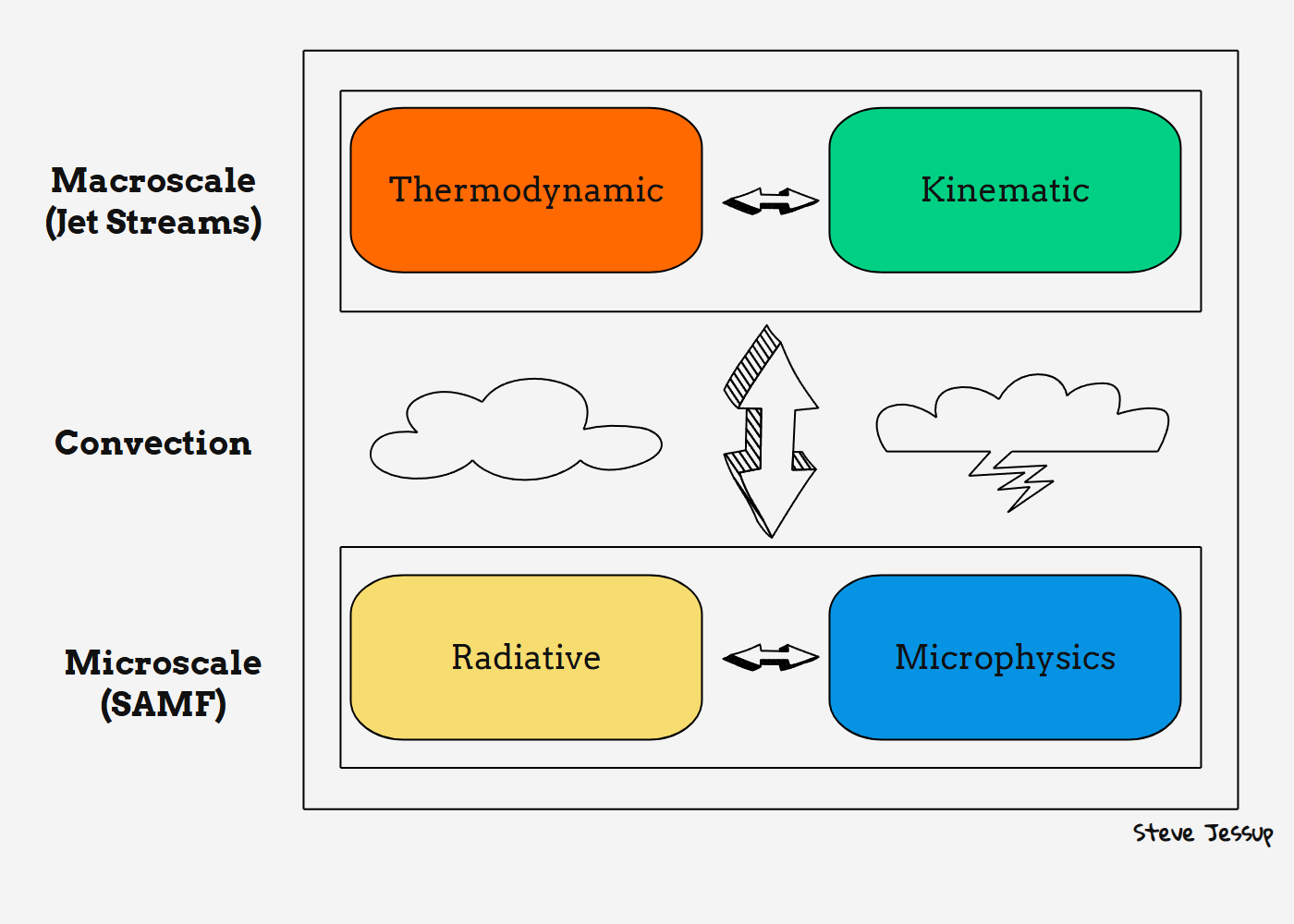
Both energy and mass evolve according to physical processes of four types that act continuously, although each process can operate on a range of characteristic scales and interacts with the others in specific ways.
Thermodynamic processes govern how temperature, density, and pressure evolve as air expands, compresses, and responds to latent heating associated with phase changes of water. Microphysical processes regulate how water changes phase and, thereby, how droplets and ice crystals form and dissipate. Radiative processes determine how ultraviolet, visible, and infrared radiation flows through the atmosphere and interacts with the surface, clouds, molecules, and particles. Kinematic processes determine how momentum is transferred through wind and turbulence.
None of these processes act in isolation, since the atmosphere remains a coupled system in which a change in one variable alters the environment in which the others evolve. The structure and behavior of the atmosphere therefore emerge from the way these processes interact across the full range of spatial and temporal scales.
These scales span from the microscopic motions of water molecules to the global circulation that redistributes energy across the planet. Each scale contains its own family of processes, and each process contributes to the overall evolution of the atmosphere. The result is a system that appears complex in its details yet remains coherent in its organization, because every motion, cloud, and pattern we observe can be traced back to the underlying interactions among energy, mass, and the processes that link them.
Four Types of Atmospheric Processes: A Summary
- Thermodynamic (orange for heat): adjustments between the energy of the system and the energy of the system’s surroundings
- Microphysics (blue for water): conversions between active and potential energy through droplet and ice crystal growth or loss
- Radiative (yellow for sun): electromagnetic energy from the sun, the earth, and the atmosphere
- Kinematic (green means go): atmospheric motion
A Process-Based Framework for the Atmosphere

The graphic above shows the four types of processes in the atmosphere, more specifically in the troposphere, its lowest layer. Tropo- is the Greek root for “changing”. The troposphere extends from the surface to a height of about 11 kilometers, on average; however, its depth tends to be shallower in colder temperatures and thicker in warmer ones due to air’s tendency to expand as it warms.
At the largest scales in the troposphere, the dominant interactions arise from the coupling between thermodynamic and kinematic processes. Temperature gradients across continents and oceans establish pressure gradients. Air is then drawn from high toward low pressure, creating broad accelerations of air. These accelerations contribute to the development of the jet stream as strong midlatitude temperature contrasts strengthen horizontal pressure gradients and vertical wind shear. Thus, thermodynamic structure and kinematic response reinforce one another over thousands of kilometers, producing a directed flow that can persist for days or weeks.
At the atmosphere’s smallest scales, the balance shifts because thermodynamic and kinematic couplings no longer act alone. Especially near the surface, moisture, aerosol particles, and radiative processes structure the background temperature and humidity distributions, and this structure determines when small parcels of air become buoyant enough to rise.
Solar heating disproportionately warms the surface and lower atmosphere, strengthening the vertical temperature gradient near the surface. Once surface heating builds a large enough vertical temperature gradient such that rising motion becomes persistent, vertical currents collectively known as convection become the primary pathway by which energy and moisture are carried upward from the surface. Moisture and the aerosols it condenses on determine how quickly the temperature threshold at which condensation begins can be reached and clouds can form.
Interactions between radiative and microphysical processes helps to produce convection near the surface, just as feedbacks between thermodynamic and kinematic processes fuels the jet stream. And convection is the mechanism that re-distributes the sun’s energy throughout the depth of the troposphere and mediates the exchange of energy between small and large scales.
The pattern in which buoyant plumes of rising air release their energy influences how energy and mass redistribute across scales throughout the atmosphere and how the entire troposphere reorganizes itself from the surface to its upper boundary, since each release alters the pathways through which energy and mass circulate through the system.
The Four Types of Atmospheric Processes
Thermodynamic

Thermodynamic Processes in General
Thermodynamic processes govern how temperature, density, and pressure evolve under expansion, compression, and phase changes of water as air moves up and down in the atmosphere. They determine how fast the molecules are moving (temperature), how tightly packed they are (density), and how much force they exert on their surroundings (pressure). Mathematically, these three variables are related by the ideal gas law.
In the atmosphere, pressure and density generally maintain vertical gradients in the form of a smooth, exponential decay (see purple and yellow lines in the photo below). Pressure and density are strongly coupled in the atmosphere, and they depend on altitude.
When the air near the earth’s surface becomes sufficiently warmer than the air above, thermodynamic processes create a linear vertical gradient in temperature. We refer to the slope of this line as the lapse rate. Averaged over a long time, a constant lapse rate (red line below) extends throughout the entire depth of the troposphere (red box below).

Adiabatic Processes, Latent Heating, and Moist Convection
On a sunny day, solar radiation warms the earth’s surface. Warm air parcels (blobs of air) freely rise from near the surface, cooling and expanding as they ascend. The warm, rising current that results from surface heating – illustrated in Figure 3 below – is known as a thermal. In response, sinking air forms outside the of the thermal. These sinking air parcels warm and compress. The responses of temperature, density, and pressure as the air parcels move vertically in this convection cell are called adiabatic, and they are assumed to result in changes in these variables within the parcel, but with no exchange of heat with the surroundings.

As air parcels rise, the pressure in the surrounding environment decreases. Moving into lower pressure, the rising air parcels expand, and this increase in volume produces cooling. As rising air cools to its saturation point and continues upward, water vapor in the rising parcel condenses, producing liquid droplets. This condensation converts latent internal energy associated with water vapor into sensible thermal energy within the parcel, partially offsetting expansional cooling during ascent. If enough cloud droplets form and remain held together, a cumulus cloud forms. The cross-domain process that lifts that air to produce such cumulus clouds is known as moist convection. Deep dry convection, which does not result in cloud production, is possible in arid climates.
Let’s visualize these relationships on a diagram. As an air parcel rises, we consider it to be a closed system whose state is governed by two thermodynamic processes: adiabatic processes (top) and latent heating (bottom). Dry adiabatic processes (left left) involve the three-way interaction among temperature, pressure, and density in an unsaturated parcel of air. Pressure and density are coupled, because they display similar exponential decay throughout the atmosphere, as decreasing pressure leads to increasing volume and decreasing density. When a rising air parcel cools to saturation, condensation begins and the process becomes moist adiabatic (top right).

While moist adiabatic ascent assumes no external heat exchange between the parcel and its surrounding environment, condensation within the parcel converts latent internal energy associated with water vapor into sensible thermal energy. As water vapor condenses into liquid droplets, energy stored at the molecular scale is redistributed internally within the parcel, partially offsetting adiabatic cooling and altering the parcel’s temperature evolution relative to dry ascent.
This creates a cross-scale coupling between microscale phase changes and macroscale thermodynamic behavior, because molecular-scale condensation processes directly influence the bulk thermal structure and buoyancy of the rising air mass. The diagram captures this in the lower panel by placing microphysical processes on the small-scale side of the system and by showing how latent heating links them to the larger thermodynamic evolution of the parcel.
Weather Balloon Soundings
All of this activity inside the air parcel occurs at fixed rates as the parcel rises or descends, and so we observe that the temperature profile on a sounding (weather balloon observation) often approximates a sequence of locally linear segments and gradients. The sounding is measuring the air and dewpoint temperatures, pressure, and wind along the rising trajectory of the weather balloon’s motion, and all processes along this trajectory are continuous.

Source: University of Wyoming
The difference between air temperature and dewpoint temperature (the separation between the two bold lines on the graph above) indicates how close the parcel is to shifting from purely dry adiabatic behavior to a regime in which microphysical processes engage and latent heating begins to couple with the thermodynamic state of the rising air parcel.
Kinematic
Kinematic processes describe the how air moves under the influence of forces (pressure gradients, Coriolis acceleration, and friction). Kinematic processes serve as the atmosphere’s transport mechanism, and they are ultimately derived from Newton’s second law (Force = Mass times Acceleration). They move thermodynamic energy and mass, including water in the form of ice, liquid, and vapor. If we view thermodynamic processes as the compression and expansion that power a steam engine, then kinematic processes are the train coming down the tracks.

Source: War Is Hell Store
When kinematic movements are coupled with thermodynamic processes, they produce organized vertical currents, such as thermals. As we have seen, thermodynamic processes also couple with microphysical processes to create moist convection. The resulting cross-domain interactions among thermodynamic, kinematic, and microphysical processes determine how convective structure and organization evolves to form thunderstorms and other precipitation systems.
Wind and Turbulence
Wind can be understood as the organized motion of air that arises when pressure gradients establish a preferred direction of flow. These gradients form when temperature and density fields evolve through radiative, adiabatic, and latent-heating processes, which means that wind an expression of the thermodynamic structure beneath it. As the atmosphere adjusts toward equilibrium, air accelerates from regions of higher pressure toward lower pressure, and the resulting motion carries with it the imprint of every process that formed the underlying temperature and moisture distribution.

Source: community.wmo.int
Turbulence forms when this organized motion becomes unstable at smaller scales. Any parcel that accelerates through a non-uniform environment encounters gradients in temperature, moisture, and momentum that disrupt its trajectory. These disruptions break the flow into whirls or eddies of many sizes, although the smallest eddies are governed by the same thermodynamic constraints that carve the dry and moist adiabatic pathways. Turbulence therefore represents a loss of coherence in the flow, since the parcel can no longer maintain a single relationship among pressure, density, temperature, and microphysical activity.
Wind and turbulence often coexist because the atmosphere rarely evolves under perfectly uniform conditions. As a result, the same vertical structures that promote rising motion and phase changes also establish regions where the flow becomes uneven or even chaotic. Turbulence influences how efficiently rising air entrains or detrains surrounding air, while wind defines the larger environment in which these smaller-scale adjustments occur. In this framework, both wind and turbulence are expressions of how the the atmosphere dynamically reorganizes under the interacting constraints imposed by its thermodynamic, kinematic, and microphysical processes.
Rotation
When thermodynamic and microphysical interactions adjust the vertical structure of the atmosphere, they also change the environment in which rotation organizes itself. Rotation is always present in the atmosphere in weak, disorganized form, but it rarely produces concentrated vortices.
Rotation becomes more organized when coupling between kinematic and other processes establishes a vertical gradient in wind speed or direction, known as wind shear. This shear creates layers of air that move past one another at different velocities, and the difference in motion produces small amounts of embedded horizontal rotation, or vorticity, in the flow.

Source: Wikipedia
Under normal conditions, this vorticity remains diffuse and has no pathway to intensify, although it is always present as a background property of the flow. Turbulence then acts on this sheared environment by breaking the broader flow into eddies, each carrying fragments of this horizontal rotation. Most of these eddies remain short-lived, since they dissipate rapidly within the surrounding turbulent environment, although they still reveal the underlying structure of the shear field.
When rising motion becomes established, the situation changes because a sustained updraft can lift and stretch the vorticity that shear and turbulence have already generated. Stretching preserves angular momentum and increases the rotation rate, although this increase will only persist when the updraft remains coherent over depth.
Thermodynamic and microphysical processes maintain that coherence by controlling buoyancy, lapse rates, and the locations where phase changes occur. As the updraft deepens and cools more slowly in response to latent heating, it gains the ability to draw in and vertically align the scattered patches of rotation produced by shear and turbulence. This alignment allows rotation to shift from a diffuse background property to an organized, vertically oriented circulation.
Tornadoes: A Process-Based Framework
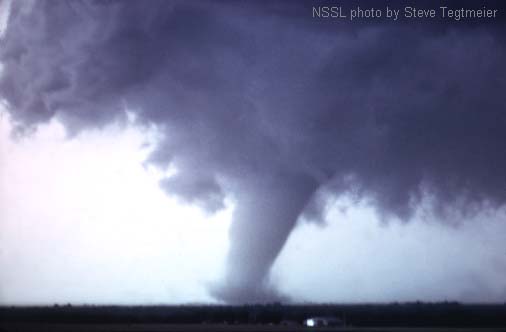
A tornado requires a set of conditions in which the evolving temperature and moisture structure lowers the strength of the density gradient in a rising current while preserving the ambient wind shear that supplies horizontal vorticity. When a rising parcel approaches saturation, latent heating allows the updraft to maintain buoyancy for a greater depth by reducing the updraft’s lapse rate and slowing its rate of cooling. The deeper buoyant column that is produced can then lift and stretch the background vorticity that already exists in the environment.
Source: Wikimedia Commons
The stretching increases the rotation rate through angular momentum conservation, in much the same way that a skater spins faster by lifting his arms. Stretching amplification only becomes sustained when the thermodynamic environment supports a persistent buoyant updraft. As the column elongates vertically, the same rotational momentum becomes distributed through a narrower horizontal radius, increasing the local spin rate while simultaneously coupling the dynamical evolution of the vortex to the buoyant structure of the parent updraft. This means that rotation amplification is not simply a kinematic process imposed on the flow independently, but instead emerges from the interactions among vertical acceleration, buoyancy generation, pressure adjustment, and the continuity constraints governing the evolving storm circulation.
Microphysical
Microphysical processes provide the physical fuel for the atmosphere’s kinematic engine. An engine only moves if something else makes it move. The fuel is water, and the “combustion” of that fuel occurs through water’s phase changes: solid, liquid, gas. Microphysics involves not only the phase changes of water, but also the interactions between water and aerosols (small solid and liquid particles). Aerosols provide the sites on which water vapor condenses to form liquid droplets.
Of the phases of water, liquid droplets are especially important because they are most equipped to efficiently recycle thermodynamic energy at a bulk scale through the exchange of latent heat with the surroundings. Although microphysical processes occur at micrometer scales, wider kinematic and thermodynamic processes organize droplet production, creating concentrated regions of phase changes that power storms.
The Subcritical Aerosol-Moisture Feedback
Microphysical processes may be involved in a three-way Subcritical Moisture-Aerosol Feedback (SAMF) among moisture, aerosols, and radiation, particularly when aerosol concentrations are high. The term “subcritical” refers to environmental states that remain below the threshold for sustained deep convection, yet continue accumulating structural and thermodynamic changes that may later influence convective initiation.
My peer-reviewed case study of the April 2024 solar eclipse documents boundary-layer responses in smoky and clear-air environments during the eclipse. By combining the data with observations from the literature, I proposed SAMF as a mechanism by which aerosol-moisture-radiative interactions may maintain steady-state thermodynamic conditions under changing radiative forcing during this case, and as a process that may more generally influence pre-convective boundary layer conditions, especially when aerosol counts are high.
When radiative forcing changes, such as during the morning as the sun angle becomes more direct, the surface layer begins to reorganize its temperature and moisture structure. The increase in shortwave radiation warms the ground and accelerates evaporation, which raises the humidity of the air immediately above the surface. Aerosol particles may then absorb this moisture according to their composition and size, and these population characteristics may help to determine how quickly the vapor field approaches saturation.

As the radiative input continues to rise, the boundary layer experiences repeated cycles of slight warming and slight moistening, particularly once thermals begin to form, and these cycles alter the balance between adiabatic cooling in rising parcels and the latent heating that accompanies condensation. As local conditions approach saturation and aerosols become wetted, their radiative properties change, especially in the infrared. Small, localized changes in moisture, aerosol hydration state, and radiative transfer may begin influencing one another through repeated adjustments, which may accumulate as small structural evolutions within the boundary layer.

This pattern of adjustment lies at the core of the proposed Subcritical Aerosol–Moisture Feedback. SAMF posits that the boundary layer remains below the threshold for deep convection, yet the interactions among moisture, aerosols, and radiative forcing allow the system to store energy in a manner that may not immediately be converted to buoyant ascent. Rather, each increment of radiative warming modifies the humidity field; each change in humidity alters the propensity of aerosols to take up water; and each resulting microphysical adjustment to the environment accelerates or slows the conversion of latent heating into buoyancy via rising parcels. The idea is that the feedback can either suppress or accelerate the onset of convection, depending on the responses within the system.
The feedback may become legible when these changes reinforce one another, allowing the boundary layer to retain moisture and energy more effectively than traditional parcel theory would suggest. As the morning progresses, the system becomes increasingly primed for release, even though no single process is strong enough to initiate deep convection on its own. At the same time, these feedbacks may explain why sometimes the atmosphere may reach the threshold for convection – the convective temperature – yet the onset of convection may be delayed.
Microphysical Control of Lapse Rates and Convective Readiness
As SAMF strengthens, the resulting microphysical and thermodynamic adjustments may begin influencing the lapse-rate structure itself. Increased moisture retention within the boundary layer raises the dewpoint and reduces the adiabatic cooling required for rising parcels to reach saturation. Earlier saturation increases the contribution of latent heating during ascent, slowing the parcel’s effective lapse rate and allowing buoyancy to develop more efficiently once persistent upward motion begins. Over time, these adjustments may increase the atmosphere’s convective readiness even before visible cloud formation occurs.
Even before convection initiates, the boundary layer may become increasingly vertically structured as interactions among moisture, aerosols, and radiative forcing reorganize the near-surface thermodynamic profile. Variations in boundary-layer moisture and aerosol hygroscopicity may influence how efficiently buoyancy develops once sustained rising motion begins. In this way, SAMF suggests that cross-domain feedbacks may begin modulating the thermodynamic profile before visible cloud formation occurs, creating the conditions under which a later release can occur rapidly and with greater depth.
These relationships could depend upon aerosol composition, in particular the relative abundance of hydrophilic and hydrophobic aerosol particles. When hydrophilic aerosols dominate, heat and moisture might be distributed more evenly by repeated aerosol wetting and drying cycles, potentially dispersing energy, which may dampen the intensity of convective onset. When hydrophobic aerosols dominate, reduced aerosol growth feedbacks may allow stronger localized gradients in heat and moisture to persist. This could potentially delay convective initiation, while accumulating latent energy in the system and thereby increasing the possibility of a more concentrated buoyancy release once convection begins. This proposed causal chain is detailed in this blog post.
SAMF remains a proposed mechanism requiring continued observational and modeled investigation, yet the process relationships outlined here suggest that aerosol-moisture-radiative interactions may play a larger role in pre-convective atmospheric organization than is typically represented in traditional parcel-based interpretations.
Radiative
Radiative processes involve the electromagnetic radiation that is produced by all objects. Right now, radiative processes are most important at the climate scale, because we’ve poured lots of greenhouse gases into the atmosphere. In an atmosphere where greenhouse gas concentrations rise rapidly, the rate at which longwave radiation escapes to space decreases, and the system becomes slower to shed the thermal anomalies produced by surface heating through radiative cooling. The atmosphere therefore spends more time in a state of elevated energy before the next episode of ventilation restores part of the vertical temperature structure.
The vertical redistribution of radiative energy by greenhouse gases has resulted in the build-up of heat in cold regions, especially at the surface, which we call Arctic amplification, and the cooling of the upper troposphere and lower stratosphere in the tropics.
Radiative processes also play a critical role within convective storms, especially near their tops and along their edges, where the atmosphere transitions from hydrometeor-rich clouds to the surrounding clear air. Longwave radiation escapes efficiently from cloud tops into the cold upper troposphere. This loss of radiative energy cools the cloud top and strengthens the density contrast that sustains rising motion from below.

Source: Wikimedia Commons
Along cloud edges, both longwave and shortwave exchanges alter the heating and cooling of droplets and ice particles, which affects how they grow, evaporate, or sublimate. These radiative adjustments feed directly into the thermodynamic and microphysical processes that govern buoyancy, latent heating, and entrainment, and they determine the depth and intensity of the updrafts that form. In this way, radiative processes help regulate the vertical pathway through which energy and moisture are transported from the surface into the upper troposphere.
At the shorter timescales that govern weather, radiative processes are primarily paired with microphysical processes because coupling among moisture, aerosols, and radiation regulates how convective potential builds and is released near the earth’s surface.
Toward a Process-Based Forecasting Approach
A process-based forecasting approach begins by identifying which families of processes are active at a given time and how they are coupling across scales. Instead of focusing on predetermined storm types or predefined regimes, the forecaster examines the balance among thermodynamic, kinematic, microphysical, and radiative processes and determines how these balances evolve.
This requires attention to where the atmosphere is gaining or losing energy, where moisture and aerosols are creating buoyancy, and where vertical or horizontal gradients are building pathways for organized motion. When seen in this way, the atmosphere becomes a continuously adjusting system in which each change in structure reflects a change in the strength or configuration of the underlying processes.
This perspective improves forecasting because it treats the relevant interactions directly rather than relying on phenomenological analogies. A forecaster who can identify when the boundary layer is primed for deep coupling, when radiative cooling at cloud top will strengthen ascent, or when microphysical activity will alter lapse rates is better positioned to anticipate how the atmosphere will reorganize itself. This approach also sharpens the diagnosis of severe weather potential, because it reveals when the atmosphere is assembling the specific combinations of buoyancy, shear, and microphysical activity that allow rotation to organize and storms to intensify.
A process-based approach therefore offers a pathway to more consistent and physically grounded forecasts, because it connects the behavior of the atmosphere at small scales to the patterns that emerge across the troposphere and ultimately give rise to the weather we observe.
Want to receive future posts related to this study in your inbox? Be sure to subscribe to this blog using the “Newsletter” link at upper right. This work is made possible by those who believe in it. Thank you for considering a gift to help ensure its continued momentum.
Author’s Note: This summary is freely available for educational use. Please cite “Jessup, S. (2025). How the Atmosphere Works: A Process-Based Framework” in scholarly work.
