tornadoes
-
Why Tornadoes Don’t Suck: The Fallacy of Suction and Low Pressure (Weather Explained #5)

Introduction When I played in the pep band in college, we had a cheer to taunt the goalie at hockey games that went something like this: You’re not a sieve; you’re a funnelYou’re not a funnel; you’re a vacuumYou’re not a vacuum; you’re a black holeYou’re not a black hole; you just suck! We didn’t… Continue reading
-
A Sophisticated Storm Events Filter for the NCEI Storm Events Database
Introduction Since 1950, local National Weather Service offices have tracked reports of severe and hazardous weather. These reports are compiled in a large online repository known as the National Center for Environmental Information (NCEI) Storm Events database. These reports serve as a record of the toll that weather takes across the U.S., logging fatalities, injuries… Continue reading
-
How the Atmosphere Works: A Process-Based Framework
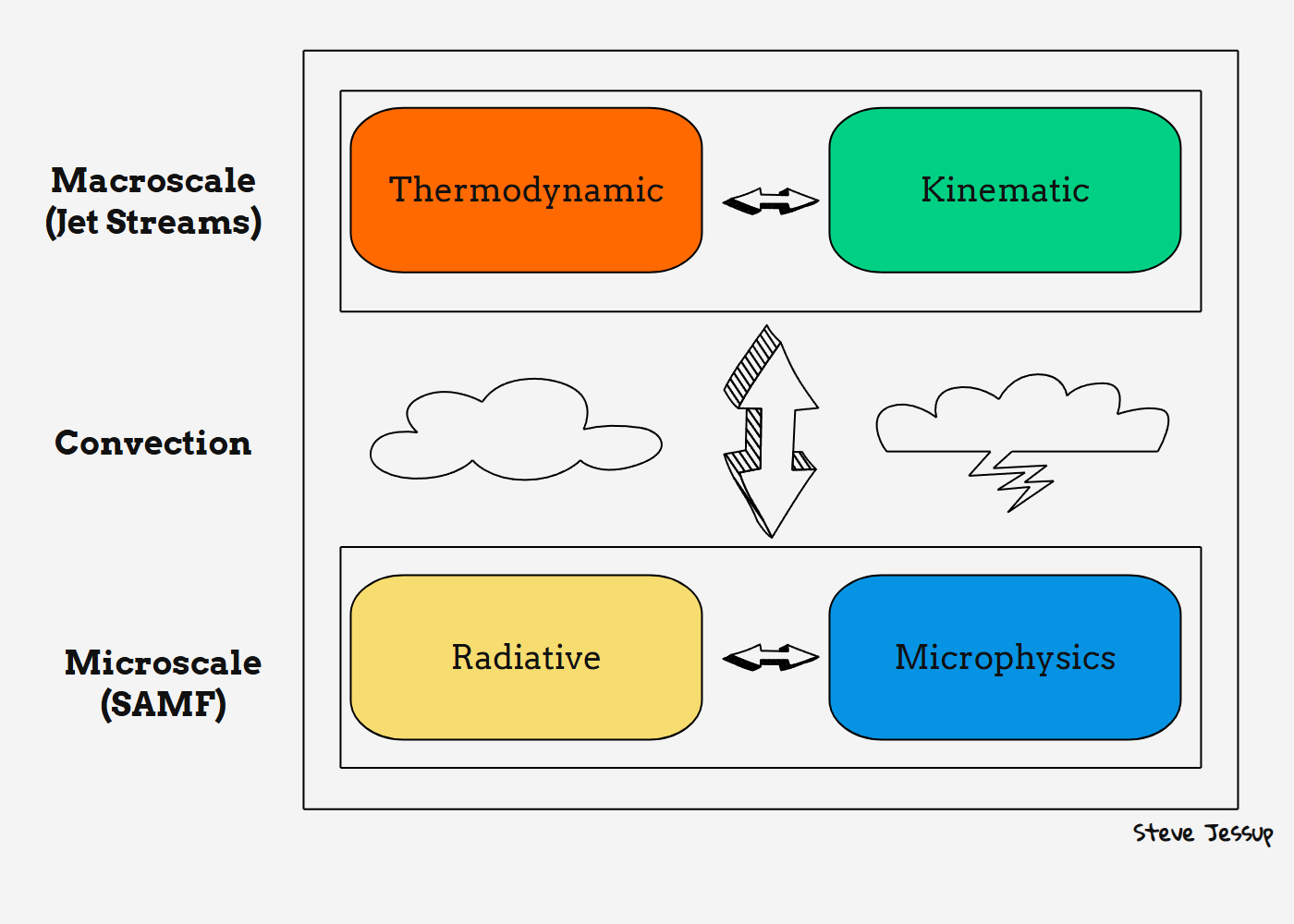
This post introduces a process-based view of the atmosphere that explains how energy and mass move through thermodynamic, microphysical, radiative, and kinematic pathways. By tracing how these processes couple across scales, from the surface to the jet stream, we gain a clearer picture of convection, storm evolution, and the connections that organize weather and climate. Continue reading
aerosol–moisture interaction, atmospheric forecasting, atmospheric processes, atmospheric science, atmospheric structure, boundary layer processes, climate science, Cloud Formation, convection, kinematics, lapse rate, meteorology, microphysics, process coupling, process-based framework, radiation, SAMF, thermodynamics, tornadoes, vertical motion, weather prediction