Table of Contents
Introduction
In my recent study of the April 8, 2024 North American Solar Eclipse, I was fortunate to witness a rare event: a solar eclipse obscured by smoke. As a meteorologist, my natural curiosity revolved around how the smoke affected the weather. Eclipses produce a unique weather response, lowering the temperature as the moon covers the sun, which affects humidity levels and local wind circulations. But during this incident, I was curious how the smoke affected the weather response locally here in Columbus, Georgia, as opposed to nearby weather stations where skies were clear.
My student, Blaire, and I gathered weather data from a handful of nearby airports🎵 and local weather stations in western Georgia. The thing that stood out most prominently: it cooled more dramatically at the other stations, and remained warmer here in Columbus. Though it’s clear that the smoke was causing the difference, the exact mechanism behind this observation remained hidden.

The Process of Discovery
As most scientists would do, I sought the answer in the scientific literature. Surely, someone had already found a viable explanation. But the more I looked, the more elusive the answer became.
Could the effect be similar to an urban heat island effect? No; smoke particles are tiny. The smaller the particles, the less direct warning effect they have. Could the smoke particles be absorbing infrared radiation, creating a “blanket” of warmth in the lower atmosphere? Nope; the only two journal articles I found that had measured infrared absorption by smoke had found a negligible amount of warming. If the literature didn’t have the answer, where should I turn?
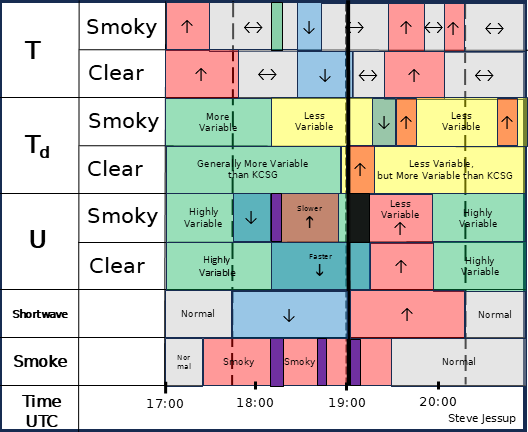
I went back to the data. If we could decode the patterns between different variables, the causative mechanism might emerge. I simplified the data, creating a timeline so that key changes in different variables would become more obvious than a line graph of the raw data.

On the timeline above, three transitions (one in particular) provided the key to discovering the explanation for the warmer temperatures at Columbus during the eclipse. Each of the transitions was marked by a “dip” in the visibility coefficient, indicated by the three purple rectangles on the “Smoke” line above. During these brief periods, the number of smoke particles briefly dropped, suggesting an interaction between the aerosols (particles) and the water vapor (moisture) in the air.
During the first transition (about 18:10), the wind speed dipped and transitioned from decreasing to increasing. At the same time, the wind speed (U) dipped as well, the dewpoint (Td) became less variable, and the temperature’s (T) variability briefly increased. With all of these variables changing simultaneously, this suggests that a system-wide adjustment occurred, but only in the smoky environment at Columbus.
When the eclipse began and the sunlight started to wane, this cooled the lower atmosphere, which caused the relative humidity to rise. Once a relative humidity threshold was reached, a feedback was triggered. Moisture became trapped in the lowest part of the atmosphere, leveling off and staying nearly constant, maintained by interactions with aerosols (smoke particles). The image below shows the feedback that ensues.

The Subcritical Aerosol-Moisture Feedback
As relative humidity rises, moisture accumulates on the aerosols, and they grow. This aerosol growth alters the scattering of infrared energy, which alters heating patterns in the surrounding air. Together with continued adjustment of relative humidity, these interactions create a “thermostat” that regulates temperature and moisture while the aerosol population fluctuates. This, in essence, is the Subcritical Aerosol-Moisture Feedback (SAMF).
The word “Subcritical” arises because the lower atmosphere is maintained in a state that resists vertical mixing. The moisture that becomes pooled in the lower part of the atmosphere by SAMF naturally wants to rise: water vapor is lighter than other molecules in the air, like oxygen and nitrogen. The interactions with aerosols, and the corresponding changes to temperature in the environment, limit this vertical mixing, keeping the atmosphere in a “subcritical” state, and keeping that moisture close to the ground. If the atmosphere heats up, as it did when sunlight returned later in the eclipse, the cycle is broken, and the moisture can freely rise.
What’s Next
Like any new scientific hypothesis, SAMF needs to be vetted for more than one case. It should be active in the morning and in the evening, as well as during wildfires and pollution episodes. I’m going to carry out some experiments on campus to seek additional evidence that may uncover additional nuance to SAMF. And I’m sure I’m not alone. Other meteorologists will likely carry out experiments as well, whether they’re taking new measurements in the field, looking back at old data, or running simulations with computer models. If and when a body of strong evidence has been built, SAMF can then be incorporated into standard computer models, improving weather forecasts and influencing climate predictions.
